ELD Supporting Documents: Retention Periods and What Inspectors Can Request
The electronic logging device mandate resolved one compliance problem — falsified paper logs — while introducing a subtler documentation challenge that conti...
Non-domiciled CDL rules changed completely in 2026. Which visa types are still valid? Is SAVE verification mandatory? Get the full compliance roadmap here.
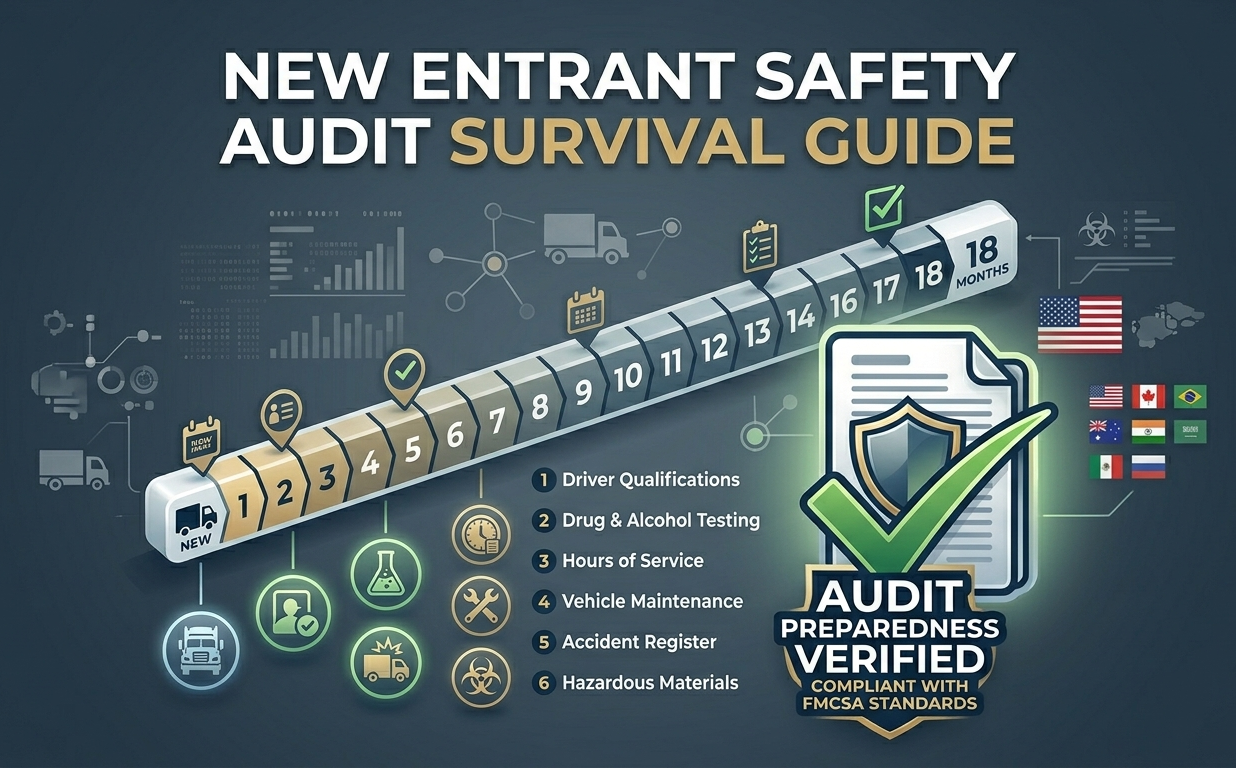
New operating authority? Learn the 6 most critical reasons carriers fail their first 18-month FMCSA audit—and exactly how to avoid them before the letter arrives.
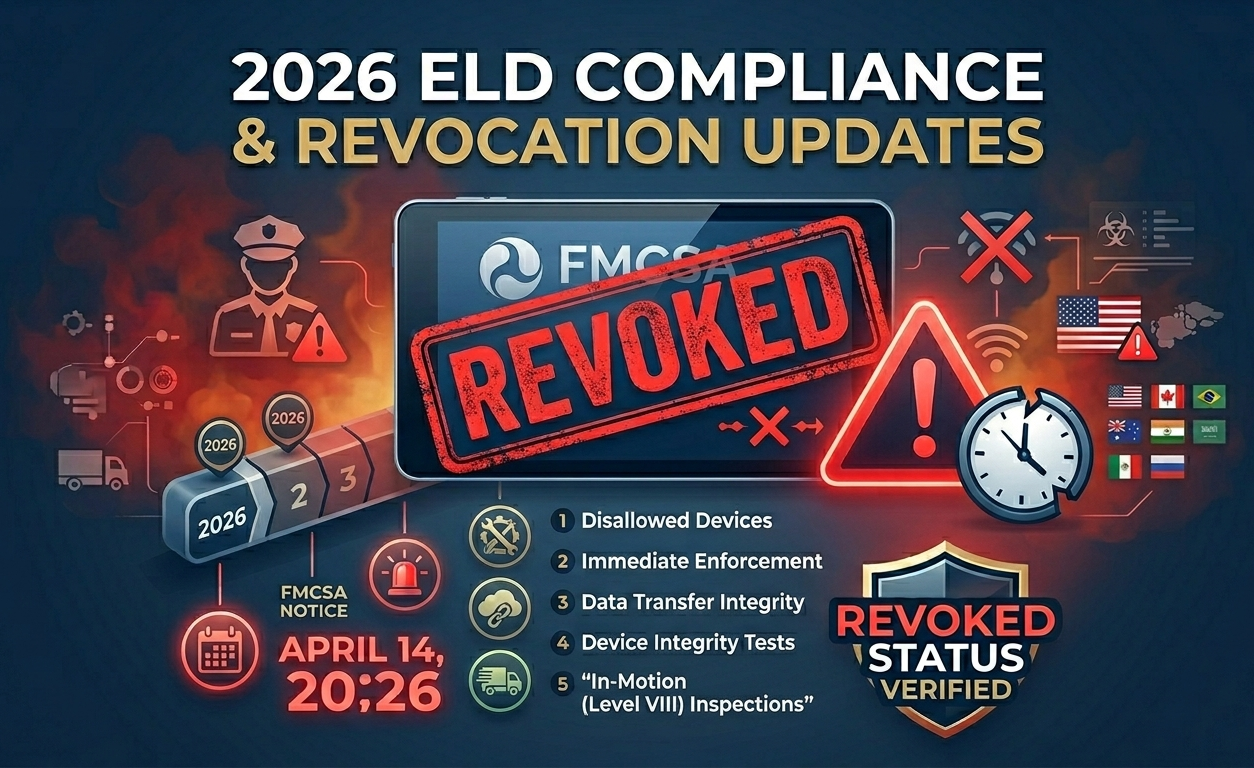
FMCSA revoked multiple ELD devices in 2026. Check the revocation list, understand the April 14 deadline, and avoid citations from Level VIII inspections.
The electronic logging device mandate resolved one compliance problem — falsified paper logs — while introducing a subtler documentation challenge that conti...
The 34-hour restart provision is one of the most operationally significant — and most frequently misapplied — mechanisms within the federal hours-of-service ...
Freight factoring is one of the most widely used cash-flow tools in trucking, and one of the least understood from a profitability standpoint. Owner-operator...
A drug or alcohol violation under 49 CFR Part 382 does not simply result in a period of suspension followed by automatic reinstatement. The regulatory archit...
Running a trucking LLC without a calculated break-even rate per mile is the operational equivalent of flying without instruments. You may feel like you’re mo...
The certificate of violations CDL driver reporting requirement under 49 CFR §391.27 occupies a critical but frequently misunderstood position in the driver q...
For motor carriers operating under FMCSA jurisdiction, few compliance failures carry consequences as immediate and operationally disruptive as driver disqual...
A monthly profit and loss statement is not a courtesy document — it is the primary diagnostic instrument for your trucking LLC’s financial health. IRS Public...
Every load offer that comes across your Transflo or carrier portal represents a binary financial event: you either generate positive contribution margin or y...
The FMCSA Drug and Alcohol Clearinghouse has logged over 200,000 drug and alcohol violations since its January 2020 mandatory implementation date. Of those v...
Accepting a load without a verified cost-per-mile figure is not optimism — it is uncontrolled risk transfer. The rate confirmation looks profitable until fue...
A trucking LLC is a legal fiction — a liability shield that exists precisely because the law treats it as an entity separate from its owner. Commingling pers...
Cross-border operations amplify every existing compliance gap. A carrier running clean domestically can accumulate out-of-service violations the moment they ...
For owner-operators leased to a motor carrier, the distinction between independent contractor and employee is not a matter of preference or mutual agreement ...
Fuel system integrity is among the most consequential mechanical compliance obligations a motor carrier faces. A single unsecured fuel cap or an undetected t...
Most hazmat carriers fixate on placarding. They verify label placement, confirm load segregation, and double-check shipping paper entries — and then walk str...
Most owner-operators treat the International Fuel Tax Agreement as a quarterly obligation to survive rather than a data system to exploit. That framing is ex...
Emergency equipment is not optional safety theater — it is a federal mandate with precise specifications, and inspectors verify every element during roadside...
The Compliance, Safety, Accountability (CSA) program generates considerably more data than the average carrier ever sees. FMCSA’s Safety Measurement System (...
Every owner-operator with a truck at or above 55,000 pounds taxable gross weight owes the Heavy Highway Vehicle Use Tax — and the IRS collects it through For...
The per diem deduction for truck drivers is one of the most consequential line items on a Schedule C or single-member LLC return — and one of the most freque...
A heavy-duty tractor can represent $150,000–$200,000 of capital outlay before a single mile is turned. How you recover that cost on your federal return — and...
Suspension system integrity is foundational to safe commercial motor vehicle operation, yet it remains among the most technically nuanced categories in roads...
Most owner-operators understand that running under their own authority means carrying more tax liability than a company driver. What many fail to internalize...
If you operate a single-member trucking LLC or run as a sole proprietor, no employer is withholding federal income tax or self-employment tax from your settl...
Most owner-operators open a bank account, start hauling, and figure the books will sort themselves out by tax season. They don’t. A poorly structured general...
When a CVSA inspector approaches a commercial vehicle at a fixed-scale facility or a mobile enforcement stop, the regulatory framework governing that interac...
For an owner-operator who hauls under their own authority, the LLC is not a formality — it is the legal membrane separating personal assets from cargo claims...
Brake adjustment remains the single most cited mechanical defect in roadside enforcement, and the margin between a compliant brake and an out-of-service cond...
The Corporate Transparency Act (CTA) generated years of compliance anxiety across the owner-operator community, and for good reason — the original statute th...
Motor carriers operating passenger-carrying commercial motor vehicles navigate a distinct regulatory framework that diverges meaningfully from the property-c...
The American Trucking Associations has tracked truckload carrier driver turnover rates for decades, and the data from ATA’s economics and industry research c...
When a carrier sells or transfers a power unit, the assumption inside many dispatch offices is that the vehicle’s roadside history resets with the new operat...
A single crash in your Safety Measurement System (SMS) record can push your Crash Indicator BASIC percentile past the intervention threshold, triggering carr...
The electronic logging device mandate transformed hours-of-service recordkeeping from a paper-based system into an engine-integrated compliance infrastructur...
Small carriers — operators running fewer than five CDL-qualified drivers — represent a disproportionate share of drug and alcohol program violations document...
Every January, FMCSA’s Office of Drug and Alcohol Policy and Compliance (ODAPC) publishes the minimum random testing rates that motor carriers must meet for ...
Most carriers treat the CSA Safety Measurement System as a single unified scoring framework. It is not. The percentile thresholds that trigger FMCSA interven...
The agricultural exemption embedded within federal hours-of-service regulations represents one of the most operationally significant—and frequently misapplie...
Team operations represent one of the most productivity-intensive configurations available to property-carrying motor carriers, but they also generate some of...
Most carriers approach broker-carrier agreements as administrative paperwork — sign, scan, move freight. That assumption is operationally dangerous. The cont...
The lease arrangement between an authorized motor carrier and an independent owner-operator sits at one of the most compliance-intensive intersections in fed...
FMCSA’s registration database contains hundreds of thousands of records in various states of administrative limbo — carriers that once operated, filed an MCS...
Every motor carrier that obtains operating authority from the FMCSA enters a structured probationary window before it can be considered a fully established r...
Longer combination vehicles occupy a distinct regulatory category that most fleet compliance programs underestimate. These configurations — Rocky Mountain do...
Rollover crashes are not evenly distributed across the commercial vehicle fleet. FMCSA Large Truck Crash Facts data consistently shows that tank trucks — par...
The Safety Measurement System (SMS) is not merely a scorecard — it is the algorithmic engine that determines when FMCSA resources are directed at your operat...
Motor carriers routinely conflate two legally distinct ELD conditions — malfunctions and data diagnostic events — and that confusion is generating citation e...
The FMCSA’s Safety Measurement System (SMS) is the quantitative backbone of federal motor carrier oversight. Within it, the Behavior Analysis and Safety Impr...
When FMCSA published its 2020 Hours of Service Final Rule — effective September 29, 2020 — the split sleeper berth provision underwent one of the most operat...
The FMCSA’s Safety Measurement System (SMS) is the primary quantitative mechanism by which the agency identifies and prioritizes motor carriers for intervent...
Most carriers that haul both residential moves and commercial freight operate under the assumption that FMCSA compliance is a single unified framework. That ...
Federal weight enforcement is among the most consequential and technically complex compliance domains in commercial motor vehicle operations. Carriers operat...
Interstate motor carriers operating qualified vehicles across multiple jurisdictions face a dual compliance obligation that many conflate or mismanage: regis...
Carriers routinely conflate two structurally distinct audit regimes — one administered by state revenue authorities under cooperative tax agreements, the oth...
Passing your new entrant safety audit feels like clearing a significant hurdle. It is not. It is the entry point to an 18-month surveillance window during wh...
The Heavy Vehicle Use Tax (HVUT) is a federal excise tax administered by the Internal Revenue Service under 26 U.S.C. § 4481, with proof of payment serving a...
The Unified Carrier Registration (UCR) system is a federally authorized, state-administered program that requires motor carriers, freight forwarders, brokers...
The federal operating authority framework governing interstate motor carrier operations is one of the most misunderstood compliance domains in commercial tra...
The Unified Carrier Registration program operates on an annual cycle, and enforcement agencies treat registration lapses as actionable violations — not admin...
Federal financial responsibility requirements sit at the intersection of public protection and operating authority. For any carrier holding active FMCSA auth...
Every August, thousands of commercial motor vehicles get pulled out of service across North America in a concentrated 72-hour enforcement window. For carrier...
Hazmat placarding is among the most visible and most scrutinized elements of hazardous materials transportation compliance. A missing, incorrect, or improper...
Shipping papers are among the most scrutinized documents in hazardous materials transportation. When a roadside inspector pulls a driver over carrying Class ...
Cargo securement failures represent one of the most operationally consequential and enforcement-intensive compliance domains in commercial motor vehicle oper...
The mechanical interface between a tractor and a semi-trailer is one of the most safety-critical junctions in commercial vehicle operations. A failed couplin...
For carriers managing Safety Measurement System (SMS) scores, a single inaccurate roadside inspection record can push a BASIC percentile past an intervention...
Seasonal and agricultural motor carriers occupy one of the most misunderstood compliance corridors in federal transportation law. The combination of time-lim...
In January 2016, FMCSA published a Notice of Proposed Rulemaking (NPRM) that would have fundamentally restructured how the agency determines whether a motor ...
Hours of service regulations are not arbitrary time limits carved from administrative convenience. Every threshold in 49 CFR Part 395 — the 11-hour driving l...
When a commercial motor vehicle is involved in a crash, the clock starts immediately — and the regulatory machinery that governs post-accident drug and alcoh...
Most enforcement actions against motor carriers follow a predictable escalation path — warning letters, compliance reviews, civil penalties, and conditional ...
A CDL downgrade does not generate an automatic alert to your safety department. There is no push notification, no DOT courtesy call, and no grace period bake...
Port drayage sits at one of the most complex regulatory intersections in US trucking. Short-haul cycles, chassis interchange arrangements, multi-party owners...
Lighting deficiencies represent one of the most consistently cited vehicle violation categories during roadside inspections — and among the most operationall...
Every compliance cycle, the same regulatory failures surface at the top of FMCSA’s enforcement ledger. The agency’s annual violation data is not ambiguous — ...
Steering system integrity sits at the apex of roadworthiness determinations for commercial motor vehicles. Unlike defects that degrade performance incrementa...
The freight industry’s accelerating adoption of electronic bills of lading has created a predictable compliance gap: carriers assume digital equals accepted,...
Leasing on to a new carrier is not a handshake agreement. It triggers a cascading series of regulatory obligations that fall on both parties — and when compl...
Understanding how FMCSA moves a carrier from administrative notice to binding legal agreement is not an academic exercise — it is operational necessity. The ...
FMCSA’s Safety Measurement System does not treat all seven BASICs equally — and neither does the research that underpins them. The agency’s regression modeli...
Collection site errors are not administrative nuisances. Under 49 CFR Part 40 Subpart F, procedural failures at the point of specimen collection generate cas...
FMCSA data consistently shows that new entrant carriers fail their safety audits at disproportionately high rates — not because their operations are inherent...
Most carriers treat roadside inspections as isolated compliance events — a driver gets pulled over, a report gets filed, and the incident is mentally closed....
Medical qualification failures remain one of the most actionable yet consistently underestimated compliance exposures in driver qualification file (DQF) mana...
Passenger carriers operating under FMCSA jurisdiction face a compliance review process that shares structural DNA with freight audits but diverges sharply in...
The gap is not subtle. Carriers operating fewer than six power units consistently post out-of-service rates that outpace large fleet benchmarks by significan...
Insurance underwriters have never had more granular access to carrier safety performance data than they do today. The FMCSA’s Safety Measurement System, publ...
Weigh stations are not passive checkpoints. They are enforcement funnels, and the sorting process begins hundreds of feet before the scale house door. Weigh-...
The periodic inspection mandate under 49 CFR Part 396 represents one of the most operationally consequential compliance obligations in the Federal Motor Carr...
When FMCSA revokes a carrier’s operating authority for safety violations or places it out of service, the regulatory expectation is straightforward: that car...
Daily Vehicle Inspection Reports (DVIRs) sit at the operational intersection of driver responsibility and carrier accountability. For motor carriers operatin...
State-level roadside enforcement is not uniformly distributed across the country. The Motor Carrier Safety Assistance Program (MCSAP) is the primary federal ...
Cargo securement violations consistently rank among the top driver out-of-service (OOS) conditions recorded during CVSA Roadcheck operations. Yet the enforce...
Fraudulent annual inspection stickers represent one of the more calculated compliance violations in commercial motor vehicle operations — not an oversight, b...
Most drivers understand that a roadside inspection can mean a walk-around of their vehicle. What catches carriers off guard is the Level III — a credential-a...
Most carriers understand that violations accumulate points in FMCSA’s Safety Measurement System. Fewer understand that the timing of those violations is just...
Roadside enforcement generates two distinct categories of out-of-service orders, and conflating them is one of the most operationally expensive mistakes a ca...
What Changed and Why It Matters: 2025–2026 Regulatory Updates for Trucking Operations
The FMCSA Drug and Alcohol Clearinghouse has fundamentally changed how drug program non-compliance surfaces in safety ratings. Since mandatory enforcement be...
A Focused Compliance Investigation (FCI) is not a preliminary inquiry. It is a targeted enforcement action with a defined evidentiary purpose, and carriers t...
The mandate for electronic logging devices has restructured HOS compliance infrastructure across the industry, yet a meaningful segment of commercial motor v...
Suspension systems rarely get the inspection attention they deserve relative to brakes and lights — yet they generate a disproportionate share of roadside ou...
ELD mandates were designed to eliminate paper log fraud. They did not eliminate log manipulation — they changed its signature. Experienced inspectors adapted...
When a commercial vehicle is involved in a reportable crash, the electronic logging device installed in that truck becomes one of the most consequential piec...
As of early 2026, the Federal Motor Carrier Safety Administration (FMCSA) has finalized a regulatory revision that significantly narrows the eligibility crit...
Interstate carriers operate under a compliance architecture that doesn’t stop at state lines — and neither does enforcement. When a carrier domiciled in Texa...
Every roadside inspection generates a data record that follows a carrier for two years inside the Safety Measurement System. Yet most carriers and even exper...
When FMCSA investigators arrive for a compliance review, the annual inspection program is one of the first maintenance system components they examine. Carrie...
Crash involvement is the single heaviest variable in FMCSA’s Safety Measurement System. Most carriers understand that crashes hurt their SMS percentile — few...
When a CDL holder tests positive for a prohibited substance under 49 CFR Part 382, the initial violation is damaging but predictable. The regulatory pathway ...
When a commercial motor vehicle rolls into a port of entry or gets flagged for a roadside stop, one of the first enforcement actions an inspector initiates i...
An unsatisfactory safety rating is not a warning. It is a regulatory countdown with a hard deadline and a defined outcome: revocation of operating authority....
Exemptions exist in the Hours of Service framework for legitimate operational reasons, but they are not self-executing shields. At roadside inspections, insp...
Carriers running informal background checks and calling it due diligence are operating on borrowed time. FMCSA’s Pre-Employment Screening Program gives motor...
The FMCSA Drug and Alcohol Clearinghouse represents one of the most consequential compliance infrastructure changes in commercial motor vehicle history. Sinc...
Reasonable suspicion drug and alcohol testing is among the most legally and operationally consequential testing categories under 49 CFR Part 382. Unlike rand...
Most carriers operating in the hazmat space have reasonable familiarity with Level I through Level V inspections. Level VI is different — and the gap between...
Every serious motor carrier compliance program has a post-accident testing policy. Fewer have one that correctly applies the regulatory decision tree under 4...
Every July, law enforcement agencies across North America execute a coordinated enforcement surge targeting commercial motor vehicle drivers and passenger ve...
Brake adjustment violations have consistently held the top position in national out-of-service data for commercial motor vehicles. This isn’t a statistical a...
Random drug and alcohol testing under 49 CFR Part 382 represents one of the most operationally demanding components of a motor carrier’s driver qualification...
Pre-employment drug testing is among the most procedurally exacting obligations a motor carrier faces during the driver qualification process. A single proce...
Reactive compliance is the fastest path to a conditional safety rating. FMCSA’s Safety Measurement System (SMS) scores carriers on a rolling 24-month window,...
When a commercial motor vehicle is involved in an accident, the regulatory clock starts immediately. Before the scene is cleared, before the insurance adjust...
Most compliance conversations about FMCSA audits center on the obvious: carriers with out-of-service violations piling up, SMS BASIC percentiles flirting wit...
Driver abandonment events create immediate operational chaos, but the regulatory exposure that follows is where carriers consistently get hurt. When a driver...
Most drivers understand that a roadside inspection is a documentation exercise. What fewer understand is that it is also a communication exercise — and the w...
The federal speed limiter rulemaking has been grinding through the regulatory process since FMCSA’s 2022 NPRM, and while a final rule has yet to be codified ...
Motor carriers routinely conflate driver licensing documentation with the full scope of pre-employment qualification requirements. A commercial driver’s lice...
Motor carriers that hold a Satisfactory safety rating frequently treat it as a permanent clearance — a signal that the agency has reviewed their operation an...
The annual motor vehicle record review is one of the most operationally consequential obligations in a motor carrier’s driver qualification program — and one...
Every roadside inspection generates a data trail that follows a carrier for years. Understanding exactly how that data moves from a weigh station or roadside...
For decades, a diagnosis of insulin-treated diabetes mellitus (ITDM) constituted an absolute disqualification from operating a commercial motor vehicle in in...
When an FMCSA compliance investigator walks through your door, they are not improvising. The DOT compliance review audit process follows a structured, sequen...
Insurance lapses are not administrative nuisances — they are operating authority termination events. Under 49 CFR Part 387, the moment a carrier’s financial ...
English proficiency enforcement is one of the most misunderstood compliance pressure points in commercial motor vehicle operations. Carriers and drivers rout...
Weight enforcement is one of the most systematically prosecuted areas of federal and state motor carrier law. Unlike hours-of-service violations, which requi...
Fuel tax compliance sits at the intersection of state revenue enforcement and federal carrier oversight — a combination that punishes administrative negligen...
The 18-month window following your operating authority registration is the highest-risk period in a motor carrier’s regulatory life. FMCSA’s New Entrant Safe...
CDL Vision and Hearing Requirements Under 49 CFR §391.41(b)
The FMCSA’s ELD revocation mechanism is not a warning system — it is a termination of technical authority. When a device loses its registration, every motor ...
Physical Qualification Standards Under 49 CFR §391.41
The annual vehicle inspection sticker is one of the most visible compliance signals on any commercial motor vehicle — and one of the most consistently misund...
When a large truck is involved in a crash, the regulatory record doesn’t stay in the enforcement lane — it moves immediately into civil litigation. Plaintiff...
Most operators mentally file an out-of-service order under “bad day at the scale.” The enforcement data tells a different story. An OOS event is a multi-vect...
A confirmed positive drug test does not simply end a driver’s career — it initiates a federally mandated return-to-duty sequence governed by 49 CFR Part 40 S...
Operating authority is not a credential you file for once and forget. Yet FMCSA new entrant data consistently shows that a significant share of owner-operato...
The medical certification framework governing commercial motor vehicle operators is among the most operationally consequential compliance domains in 49 CFR P...
Medical certificate lapses are among the most preventable compliance failures in commercial motor vehicle operations — and among the most consequential. When...
A single erroneous violation on a roadside inspection report can distort your SMS percentiles for months. FMCSA’s Safety Measurement System calculates Behavi...
An electronic logging device failure does not suspend a driver’s hours-of-service obligations — it triggers a specific, time-bound compliance protocol that m...
The yard move provision is one of the most operationally valuable—and most frequently misapplied—exceptions available under federal hours-of-service regulati...
Most drivers treat the weigh station as a weight-verification checkpoint. That framing is operationally dangerous. The moment your transponder fails to clear...
Personal conveyance is one of the most frequently misunderstood provisions in hours-of-service compliance. Carriers and drivers routinely miscategorize comme...
Every May, roughly 17,000 CVSA-certified inspectors conduct approximately 50,000 commercial vehicle inspections across North America over a 72-hour period. C...
Not all roadside violations hit your CSA score equally. A driver cited for an inoperable headlamp (393.9) walks away with a severity weight of 2. A driver pl...
Small carriers operating under 20 power units account for a disproportionate share of Unsatisfactory and Conditional safety ratings issued annually by FMCSA....
A Conditional safety rating from FMCSA is not a warning. It is a documented finding of systemic noncompliance — and it carries immediate operational conseque...
Every year, FMCSA conducts thousands of compliance reviews against motor carriers operating across the United States. From the carrier’s perspective, these i...
Most carriers have internalized the pre-employment query. It’s in onboarding checklists, it’s a gate item before a driver touches a truck. But FMCSA Clearing...
The adverse driving conditions exemption is one of the most operationally significant — and most frequently misapplied — provisions within the hours-of-servi...
Night enforcement stops are not random inconveniences. They are targeted operational windows during which roadside officers know, from years of inspection da...
A drug test refusal under 49 CFR Part 382 is not a procedural technicality. It carries the same regulatory weight as a verified positive test result — a fact...
The short-haul exemption under 49 CFR Part 395 represents one of the most operationally significant provisions in the FMCSA’s hours-of-service framework — an...
Your CSA scorecard is not a report card — it is an enforcement targeting mechanism. FMCSA uses the Safety Measurement System (SMS) to rank carriers against t...
Hazardous materials transportation failures rarely begin with catastrophic events. In most operations, they originate from fragmented documentation systems. ...
A roadside inspection is not the moment to discover what you’re missing. Officers conducting Level I, II, or III inspections under the CVSA protocol are work...
The sleeper berth provision is among the most operationally significant—and most frequently misapplied—mechanisms within the federal hours-of-service framewo...
The hours of service framework governing commercial motor vehicle operations contains no provision more consistently misunderstood — or more frequently the s...
Most owner-operators understand they need a Driver Qualification File. Fewer understand that when you are both the carrier and the driver, you are legally re...
Not every roadside inspection starts the same way. The distinction between a targeted pull and a random stop has direct financial and operational consequence...
When a commercial motor vehicle is involved in an accident, the clock starts immediately — not for the insurance adjuster, not for the repair estimate, but f...
Tires are the single most inspected component category during Level I roadside inspections, and for good reason. According to FMCSA safety data, tire-related...
The 30-minute break provision embedded in 49 CFR Part 395 generates more enforcement citations than its apparent simplicity would suggest. Drivers and fleet ...
Small carriers operating with five trucks or fewer face a structural disadvantage in the CSA system that most owner-operators don’t recognize until the damag...
A Level I inspection is the most comprehensive roadside evaluation in the North American Standard Inspection Program — covering the driver, the vehicle, carg...
Cargo securement is not a paperwork problem — it is a physics problem with federal consequences. Every year during CVSA Roadcheck, inspectors document thousa...
Few provisions in federal hours of service law generate as much confusion—or as many violations—as the 14-hour on-duty window. Unlike the 11-hour driving lim...
Small fleets — operations running fewer than six power units — account for a disproportionate share of Unsatisfactory and Conditional safety ratings issued t...
Every roadside inspection begins with the paper trail your pre-trip left behind — or failed to leave. According to FMCSA safety data and statistics, vehicle ...
Brake violations account for more out-of-service orders during CVSA inspections than any other mechanical category. During CVSA Roadcheck events, brake-relat...
Scale inspections are not random audits. Officers arrive at the inspection bay with a protocol — a checklist developed from years of enforcement pattern data...
Roadside HOS enforcement is not random. Officers working Level I, II, and III inspections operate from a structured violation taxonomy, and FMCSA’s Motor Car...
The 11-hour driving limit is the cornerstone daily constraint governing commercial motor vehicle operations in the United States. Codified at 49 CFR §395.3(a...
The FMCSA Drug & Alcohol Clearinghouse is not just another database; it is a central safety pillar of the U.S. trucking industry. Designed to track drug ...
The FMCSA Drug and Alcohol Clearinghouse has had two distinct phases. Phase I closed the loophole that let prohibited drivers move between carriers undetecte...
A DOT safety audit is not a routine paperwork review. It is a structured federal compliance examination designed to verify that a motor carrier has implement...
DOT compliance in trucking is fundamentally a documentation system. While safe driving practices and proper vehicle maintenance are essential, federal enforc...
DOT compliance is not “a few forms.” It is an operating system: a set of federal safety requirements that commercial drivers and motor carriers must follow, ...
DOT compliance refers to the full set of federal safety regulations that commercial truck drivers and motor carriers must follow in the United States. These ...
In the first quarter of 2026, the Federal Motor Carrier Safety Administration (FMCSA) significantly accelerated its technical audits of Electronic Logging De...
English language proficiency (ELP) is not a new regulatory concept. It has long been codified under 49 CFR §391.11(b)(2), which requires that a commercial mo...
Hours-of-Service (HOS) regulations are among the most strictly enforced FMCSA rules for commercial truck drivers. These regulations limit how long drivers ma...
The FMCSA New Entrant Safety Audit is a federal compliance verification conducted within the first 18 months after a motor carrier receives operating authori...
The New Entrant Safety Audit is not a formality. Under 49 CFR Part 385, Subpart D, every motor carrier domiciled in the United States or Canada that obtains ...
ELD compliance is no longer a “set-and-forget” hardware installation; it is a dynamic process of data integrity and regulatory vigilance. As of February 2026...
DOT roadside inspections follow structured enforcement protocols under the North American Standard (NAS) inspection program. What escalates a routine inspect...
On July 24, 2025, FMCSA and NHTSA formally withdrew the 2016 heavy-vehicle speed limiter NPRM, ending nearly a decade of regulatory uncertainty. However, the...
On February 10, 2026, PHMSA published HM-215R (Docket PHMSA-2023-0111), initiating a new harmonization cycle for 49 CFR Parts 171-180. On February 10, 2026, ...
49 CFR § 391.11(b)(2) establishes English language proficiency as a core driver qualification requirement, yet its roadside enforcement remains widely misund...
Every DOT-regulated motor carrier assumes maximum regulatory exposure at a single operational moment: the point at which a newly onboarded driver is permitte...
Effective April 1, 2026, the CVSA North American Standard Out-of-Service Criteria introduces 17 enforcement amendments that materially alter roadside exposur...
In February 2026, the Federal Motor Carrier Safety Administration (FMCSA) initiated a significant enforcement action by removing nine Electronic Logging Devi...
In the high-stakes theater of American logistics, the Driver Qualification File (DQF) represents the operational bridge between day-to-day trucking activity ...
In the architectural framework of American trucking, safety has long been measured through the backward-looking lens of a periodic compliance review. However...
For many truck drivers, the sight of a “Scale Open” sign or a trooper’s lights brings a wave of anxiety. However, DOT roadside inspections are predictable, s...
Hours-of-Service violations are one of the fastest ways to get a driver placed out-of-service during a roadside inspection. This guide breaks down the most c...
Brake defects are among the most common vehicle out-of-service triggers because they are easy to verify and hard to excuse. This article explains what typica...
The Federal Motor Carrier Safety Administration (FMCSA) is the U.S. government agency responsible for regulating commercial motor vehicle safety. While many ...
ELD compliance is not a device problem — it is a process problem. Whether your logs hold up at a roadside inspection or collapse under an FMCSA audit depends...
Most roadside maintenance violations come from missing structure, not rare mechanical failures. A documented inspection-and-repair routine aligned to 49 CFR ...
Recordkeeping problems often create enforcement exposure even when operations are otherwise compliant. A simple retention system and periodic file audits red...
DOT audits are rarely random events. They are usually triggered by patterns—inspection history, CSA indicators, crash trends, or documentation weaknesses tha...
Most DOT violations are preventable and tend to repeat for the same operational reasons—inspection gaps, documentation drift, and missed thresholds. This gui...