What Is DOT Compliance? Complete Guide for Truck Drivers (2026)
DOT compliance refers to the full set of federal safety regulations that commercial truck drivers and motor carriers must follow in the United States. These rules are not optional, and failure to comply can result in fines, out-of-service orders, civil penalties, or enforcement actions.
At its core, DOT compliance exists to support road safety, driver accountability, and safe vehicle operation across the national transportation system. Most day-to-day trucking compliance requirements are enforced by the Federal Motor Carrier Safety Administration (FMCSA), an agency within the U.S. Department of Transportation.
Official source: https://www.fmcsa.dot.gov
For a foundational overview of the agency responsible for these rules, see What Is FMCSA?
DOT compliance is therefore not a single form or registration. It is the ongoing operational responsibility of running commercial transportation inside a federally regulated safety framework.
What DOT Compliance Actually Means
In practice, DOT compliance means that a commercial driver or motor carrier can demonstrate — through documentation, operational controls, and roadside behavior — that they consistently operate within federal safety regulations.
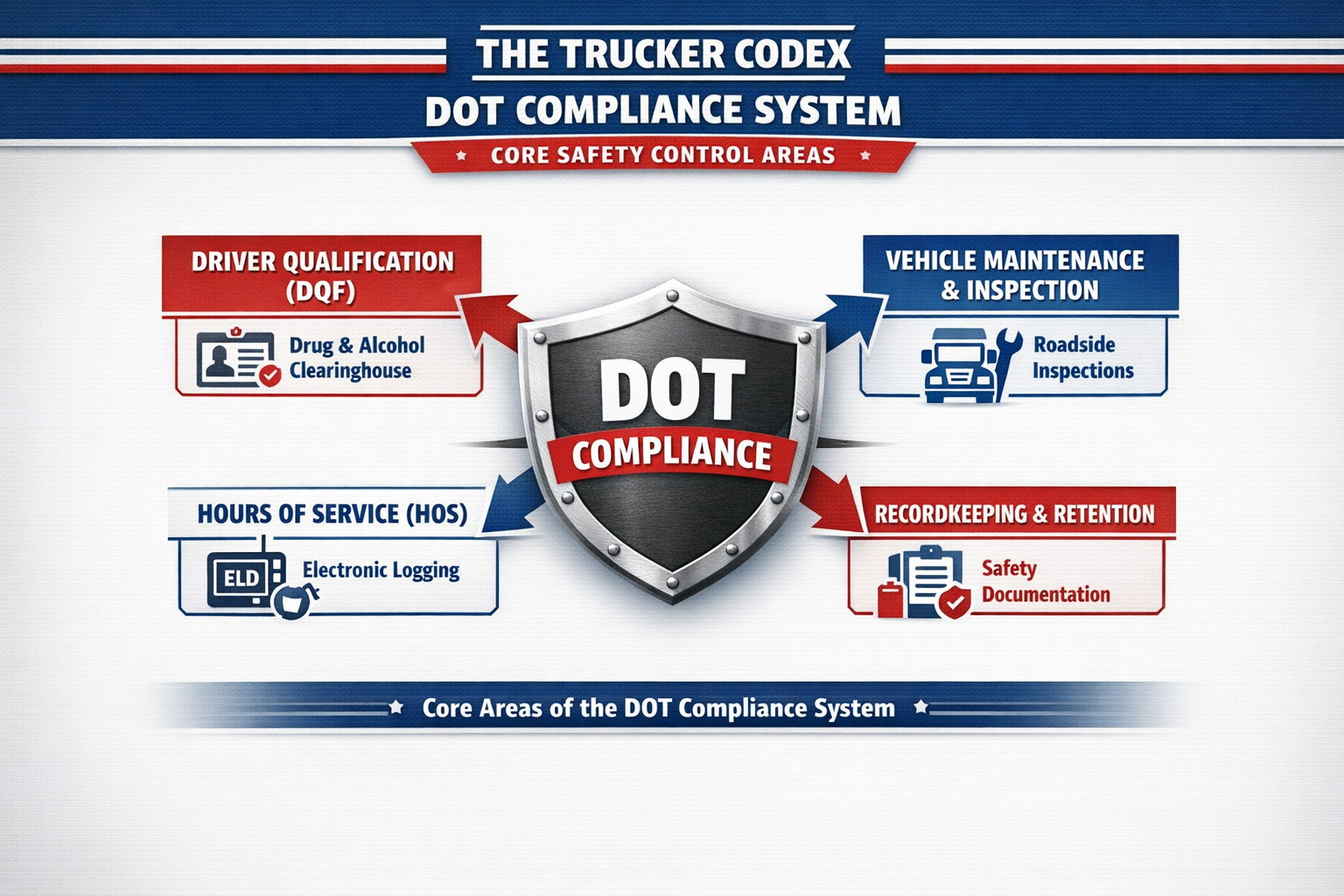
Many new drivers assume compliance simply means “having a CDL and an operating authority.” The regulatory reality is broader. DOT compliance involves structured control of:
- driver qualification
- hours-of-service limits
- vehicle inspection and maintenance
- safety recordkeeping
- drug and alcohol testing requirements
- roadside inspection readiness
A carrier can be operating safely and still fail compliance if documentation is incomplete or poorly maintained. Enforcement agencies evaluate both operational behavior and documented safety management controls.
For an overview of compliance-focused enforcement triggers, see DOT Compliance Audit Triggers
Who Must Follow DOT Compliance Rules
DOT compliance requirements generally apply to drivers and carriers operating commercial motor vehicles (CMVs) in interstate commerce.
Typical operations that fall under FMCSA safety regulations include:
- owner-operators hauling freight across state lines
- small fleets operating commercial trucks
- carriers operating vehicles over 10,000 lbs GVWR in interstate commerce
- passenger carriers operating commercial vehicles
- hazmat carriers subject to additional safety regulations
Even small operations must maintain compliance systems. The absence of a dedicated compliance department does not reduce regulatory responsibility.
What Does DOT Compliance Include?
DOT compliance covers several operational domains. These areas represent the core enforcement framework used by FMCSA and state roadside inspection agencies.
The most important compliance domains include:
- Driver qualification and documentation
- Vehicle inspection, repair, and maintenance
- Hours-of-Service (HOS) and log accuracy
- Recordkeeping and document retention
- Drug and alcohol testing compliance
Each of these domains contains specific documentation requirements and enforcement exposure points.
Topic hubs within The Trucker Codex that explore these areas include:
- FMCSA & DOT Basics
- HOS & ELD
- Driver Qualification File (DQF)
- Vehicle Inspection & Maintenance
- Recordkeeping & Retention
- Audits & Violations
Driver Qualification and Documentation
One of the central components of DOT compliance is the Driver Qualification File (DQF). The DQF is a structured documentation file that proves a driver is legally qualified to operate a commercial motor vehicle.
Full guide: Driver Qualification File Requirements
A properly maintained DQF typically includes documentation verifying:
- commercial driver’s license validity
- medical certification status
- employment history verification
- safety performance records
- annual driver record review
Failure to maintain a complete driver qualification file can create immediate compliance exposure during audits or compliance reviews.
Pre-employment compliance controls are also essential. Many carriers encounter regulatory violations during hiring procedures when background verification and qualification documentation are incomplete.
Detailed guide: DOT Pre-Employment Requirements
Drug and alcohol testing compliance is also part of the driver qualification framework through the FMCSA Clearinghouse system.
See: FMCSA Clearinghouse Guide
Vehicle Inspection, Repair, and Maintenance
DOT compliance also requires carriers to maintain vehicles in safe operating condition and to document inspection and repair activity.
Vehicle safety documentation typically includes:
- driver vehicle inspection reports (DVIR)
- periodic inspection records
- repair and maintenance logs
- defect correction documentation
Detailed explanation: DOT Vehicle Inspection and Maintenance Requirements
Mechanical failures can lead directly to out-of-service conditions during roadside inspections. Two of the most common high-risk areas include brake systems and tire defects.
Relevant enforcement criteria:
Maintenance compliance therefore involves both safe mechanical operation and documented inspection discipline.
Hours of Service and Log Accuracy
Hours-of-Service regulations are designed to reduce fatigue-related crash risk by limiting how long drivers may operate commercial vehicles.
Primary reference guide: Hours of Service Rules
Drivers must maintain accurate records of duty status (RODS), typically through electronic logging devices (ELDs).
Full explanation: Electronic Logging Device (ELD) Compliance
Certain HOS violations can result in immediate out-of-service orders during roadside inspections.
See: Hours of Service Violations and Out-of-Service Conditions
ELD device status is also part of compliance oversight. Devices can be revoked by FMCSA if they fail regulatory certification requirements.
Recent enforcement analysis:
- 2026 ELD Compliance Standards and Revocation Updates
- FMCSA 2026 Revoked ELD Devices and Compliance Strategies
Recordkeeping and Document Retention
DOT compliance frequently depends on documentation quality. Even safe operations can fail regulatory reviews when documentation is incomplete or improperly retained.
Required safety records often include:
- driver qualification documentation
- inspection and maintenance records
- accident registers
- hours-of-service logs
- drug and alcohol testing records
Detailed explanation: DOT Recordkeeping and Document Retention Requirements
A structured document retention system helps ensure records remain accessible during roadside inspections or compliance audits.
Roadside Inspections and Enforcement
DOT compliance rules are enforced through roadside inspections, safety audits, and compliance reviews conducted by federal and state enforcement agencies.
Roadside inspections are structured enforcement events that evaluate both vehicle condition and driver documentation.
Guide: DOT Roadside Inspection Levels
Driver communication and documentation presentation also influence inspection outcomes.
See: DOT Roadside Communication Structure
New carriers are also subject to structured safety monitoring programs.
Explanation: New Entrant Safety Audit Methodology
Practical preparation guide: New Entrant Safety Audit Survival Guide
Why DOT Compliance Matters for Truck Drivers
DOT compliance directly affects a driver’s ability to operate legally and maintain uninterrupted business activity.
Consequences of non-compliance may include:
- civil fines and penalties
- out-of-service orders
- increased inspection frequency
- audit exposure
- insurance cost increases
Owner-operators and small fleets often face greater compliance risk because the driver also serves as the compliance manager.
Understanding regulatory expectations and maintaining accurate records is therefore essential for sustainable trucking operations.
Common DOT Compliance Mistakes
Several recurring compliance issues appear during roadside inspections and safety audits.
Common problems include:
- incomplete driver qualification files
- expired medical certifications
- inaccurate or missing HOS logs
- poorly documented vehicle inspections
- repeated unresolved vehicle defects
Many violations occur because drivers rely on informal practices rather than structured compliance procedures.
Practical enforcement-focused guide: Common DOT Violations and How to Avoid Them
DOT Compliance Updates and Regulatory Changes
Regulatory language may remain stable for long periods, while enforcement policies and operational guidance evolve.
Recent regulatory context:
- FMCSA DOT Updates 2025–2026
- FMCSA Safety Fitness Determination Overhaul
- CVSA 2026 Out-of-Service Criteria Changes
Monitoring regulatory updates helps drivers and carriers adapt compliance procedures before enforcement changes take effect.
Related Compliance Topics
- Driver Qualification File Requirements
- DOT Vehicle Inspection and Maintenance Requirements
- Hours of Service Rules
- Electronic Logging Device Compliance
- DOT Recordkeeping and Document Retention
- DOT Compliance Audit Triggers
- Common DOT Violations and How to Avoid Them
Related Compliance Guides
DOT Compliance FAQ
What is DOT compliance in trucking?
DOT compliance refers to the federal safety regulations that commercial truck drivers and motor carriers must follow when operating commercial motor vehicles in the United States. These rules are primarily enforced by the Federal Motor Carrier Safety Administration (FMCSA) and include requirements related to driver qualification, hours-of-service limits, vehicle inspections, drug and alcohol testing, and safety recordkeeping.
Who must follow DOT compliance rules?
DOT compliance rules generally apply to drivers and carriers operating commercial motor vehicles in interstate commerce. This includes owner-operators, small trucking fleets, and larger motor carriers operating vehicles with a gross vehicle weight rating (GVWR) above 10,000 pounds or transporting regulated cargo.
What documents are required for DOT compliance?
Typical DOT compliance documentation includes driver qualification files (DQF), medical certification records, hours-of-service logs, vehicle inspection and maintenance records, accident registers, and drug and alcohol testing program documentation.
What happens if a driver fails DOT compliance?
Failure to comply with DOT regulations may result in fines, out-of-service orders, increased inspection frequency, compliance audits, and potential enforcement actions affecting operating authority.
How is DOT compliance enforced?
DOT compliance is enforced through roadside inspections, safety audits, and compliance reviews conducted by federal and state enforcement agencies.
Is DOT compliance only about the driver?
No. DOT compliance applies to both drivers and motor carriers. Drivers must follow operational safety rules such as hours-of-service limits and roadside inspection procedures, while carriers are responsible for maintaining safety management systems and regulatory documentation.
Written on February 8, 2026 Updated March 3 2026