Technical Standards for Non-Domiciled CDL Issuance and SAVE Verification (2026 Update)
As of early 2026, the Federal Motor Carrier Safety Administration (FMCSA) has finalized a regulatory revision that significantly narrows the eligibility criteria for non-domiciled Commercial Driver’s Licenses (CDLs). This update aligns federal compliance with statutory safety and verification standards, largely reaffirming the interim final rule issued in September 2025. This technical shift addresses systemic state noncompliance identified through rigorous FMCSA enforcement and audit findings across various jurisdictions. The primary goal is to eliminate the discrepancies between state-level issuance practices and federal immigration oversight, ensuring that every commercial driver on U.S. roads has undergone a standardized vetting process.
For a broader perspective on how these changes fit into the current regulatory landscape, see our guide on FMCSA and DOT Updates for 2025-2026.
Regulatory Framework: 49 CFR Part 383
The 49 CFR Part 383 (Commercial Driver’s License Standards) establishes the federal requirements for the issuance, renewal, and oversight of CDLs by State Driver Licensing Agencies (SDLAs). This framework includes minimum qualifications, lawful presence verification, and mandatory driver history checks via the Commercial Driver’s License Information System (CDLIS) and the Problem Driver Pointer System (PDPS).
Under the updated FMCSA rule, SDLAs issuing non-domiciled CDLs must now comply with enhanced verification requirements that exceed pre-existing informal guidance. Failure of an SDLA to adhere to these standards can trigger significant DOT Compliance Audit Triggers for carriers operating in those states, as the federal government may de-certify state-issued licenses that do not meet the 2026 SAVE verification threshold.
Eligibility Criteria for Non-Domiciled CDL Holders
1. Limited Visa Categories
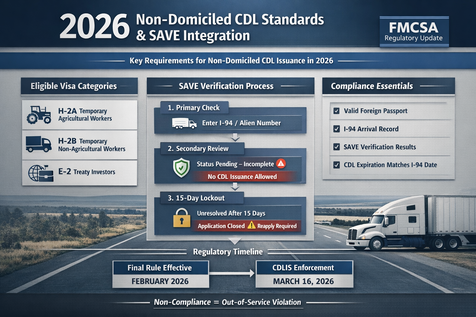
The final rule restricts eligibility exclusively to foreign-domiciled individuals holding specific employment-based nonimmigrant classifications. These categories involve high-level consular vetting and interagency screening before the individual enters the commercial workforce:
- H-2A (Temporary Agricultural Workers): Specifically utilized for seasonal agricultural transport operations, often restricted to specific geographic regions or commodities.
- H-2B (Temporary Non-Agricultural Workers): Frequently applied in general freight, logistics, and non-agricultural trucking sectors where a temporary labor shortage has been certified.
- E-2 (Treaty Investors): Applicable to individuals from qualifying treaty countries who maintain active management roles or highly specialized technical roles in U.S. trucking enterprises.
2. Exclusion of EAD-Only Status
Employment Authorization Documents (EADs), including the common C08 (Asylum Pending) and C09 (Adjustment of Status) categories, as well as DACA status, are no longer acceptable as standalone proof of eligibility for a non-domiciled CDL. Applicants must now provide a valid foreign passport accompanied by a matching I-94 (Arrival/Departure Record) that explicitly reflects an eligible visa classification. This change removes the “discretionary issuance” previously practiced by certain states, creating a unified federal barrier to entry for commercial driving privileges.
(Buraya az önce hazırladığımız tabloyu yapıştırabilirsin)
Technical Workflow: The SAVE Verification Process
The most significant technical change is the mandated use of the USCIS Systematic Alien Verification for Entitlements (SAVE) system. This ensures federal confirmation of an applicant’s immigration status rather than relying solely on physical documentation which can be prone to administrative delays or errors.
The SAVE Process Prior to Issuance:
- Primary Input: The SDLA enters the I-94 or Alien Registration Number into the SAVE portal.
- Verification of Category: The system must confirm the status falls within the H-2A, H-2B, or E-2 categories. Any other result, even if it allows general work authorization, must result in a denial of the CDL application.
- Secondary Manual Review: If the primary verification is “Pending,” the applicant enters a manual review phase by USCIS officers. Under 2026 rules, SDLAs are strictly prohibited from proceeding with license issuance or renewal while a SAVE review is in this “Incomplete” stage.
This rigid verification is critical during DOT Roadside Inspections, where inspectors verify the driver’s commercial privilege in real-time through the CDLIS database, which is now bridged with SAVE data.
Document Retention and Validity Limits
SDLAs are required to retain copies of passports, I-94 records, and SAVE query responses for at least two years for audit purposes. Furthermore, a non-domiciled CDL or CLP (Commercial Learner’s Permit) must not extend beyond:
- The expiration date listed on the applicant’s valid I-94 record.
- Or a maximum of one year—whichever period is shorter.
This “shorter of the two” rule forces a continuous cycle of verification, reinforcing the importance of meticulous DOT Recordkeeping and Document Retention for the motor carrier’s safety department.
Operational Impact on Carriers and Enforcement
Driver Qualification Files (DQF)
Motor carriers must update their internal qualification protocols immediately. It is no longer sufficient to merely have a copy of the CDL. To maintain a compliant Driver Qualification File, carriers must now prove they have verified the driver’s legal presence independently. This includes:
- Verifying that the non-domiciled license was issued after a successful SAVE check.
- Maintaining a “Document Expiry Tracker” that monitors both the CDL expiration and the I-94 expiration.
- Confirming that the driver has not transitioned into a “Non-Domiciled” status that is no longer recognized by the 2026 rule.
Failure to maintain these records can result in “Acute” violations during a New Entrant Safety Audit, leading to an immediate “Unsatisfactory” rating.
Roadside Enforcement and CDLIS Integration
During roadside enforcement, if a non-domiciled CDL does not have its SAVE-verified legal status documented in the national database, the license may display as “Invalid” or “Canceled” in the CDLIS system, even if the driver is holding a physical card that appears valid. Under the latest CVSA 2026 Out-of-Service Criteria, an invalid license status results in an automatic out-of-service violation for the driver and potential fines for the carrier.
Strategic Compliance SOP for Carriers
To ensure operational continuity and avoid fleet-wide disruptions, carriers should adopt the following Standard Operating Procedure (SOP):
- Initial Fleet Audit: Review the non-domiciled driver population to identify those who may hold visas outside the H-2 and E-2 categories.
- Proactive Documentation: Collect and scan foreign passports and I-94 forms for every non-domiciled driver.
- Electronic DQF Integration: Incorporate immigration status expiration dates into your electronic logging or dispatch systems to prevent dispatching drivers with expiring legal status.
- SDLA Coordination: Encourage drivers to begin their renewal process at least 90 days in advance to allow for potential SAVE secondary review delays.
Conclusion
The 2026 FMCSA final rule represents a paradigm shift in federal CDL policy for non-domiciled drivers. By prioritizing uniform lawful presence verification and enhanced interagency screening via SAVE, these standards close historical gaps in commercial driver oversight. For carriers, these regulations demand a higher level of vigilance in driver qualification and record-keeping. Staying ahead of the March 16 deadline is not just a matter of paperwork; it is a critical strategy for maintaining fleet mobility and regulatory integrity in a tightening enforcement environment.
External References:
- Federal Motor Carrier Safety Administration: Official FMCSA Website
- USCIS SAVE System: SAVE Case Check and Verification
- Code of Federal Regulations: 49 CFR Part 383 – Commercial Driver’s License Standard