FMCSA 2026 Update: Comprehensive List of Revoked ELD Devices and Compliance Strategies
In the first quarter of 2026, the Federal Motor Carrier Safety Administration (FMCSA) significantly accelerated its technical audits of Electronic Logging Devices (ELDs). As part of a broader FMCSA 2026 safety overhaul, the agency has transitioned a large volume of hardware from “Registered” to “Revoked” status. This aggressive stance on data integrity is no longer a suggestion; it is a full-scale enforcement move that catches unprepared carriers off guard during roadside inspections.
For carriers, the implications of these revocations are severe. Operating with a revoked device is legally equivalent to having “No Record of Duty Status” (RODS). This is a high-severity violation that often results in immediate Out-of-Service (OOS) orders, causing massive delays in the supply chain and irreversible damage to a fleet’s safety profile.
Understanding the Technical Basis for Revocations
The FMCSA does not revoke ELDs arbitrarily. A device is moved to the revoked list when it fails to meet the minimum technical requirements mandated by 49 CFR Part 395, Appendix A. These standards ensure that an ELD can accurately capture, record, and—most importantly—transfer data to safety officials during an inspection.
Common reasons for the recent 2026 revocations include failure to provide required data elements to safety officials, inability to resist tampering, and inconsistent synchronization with the vehicle’s Engine Control Module (ECM). When these technical thresholds are missed, the FMCSA triggers a removal process that leaves carriers with a limited window for action. This is a central pillar of what DOT compliance is in the modern era: technical accountability and transparency.
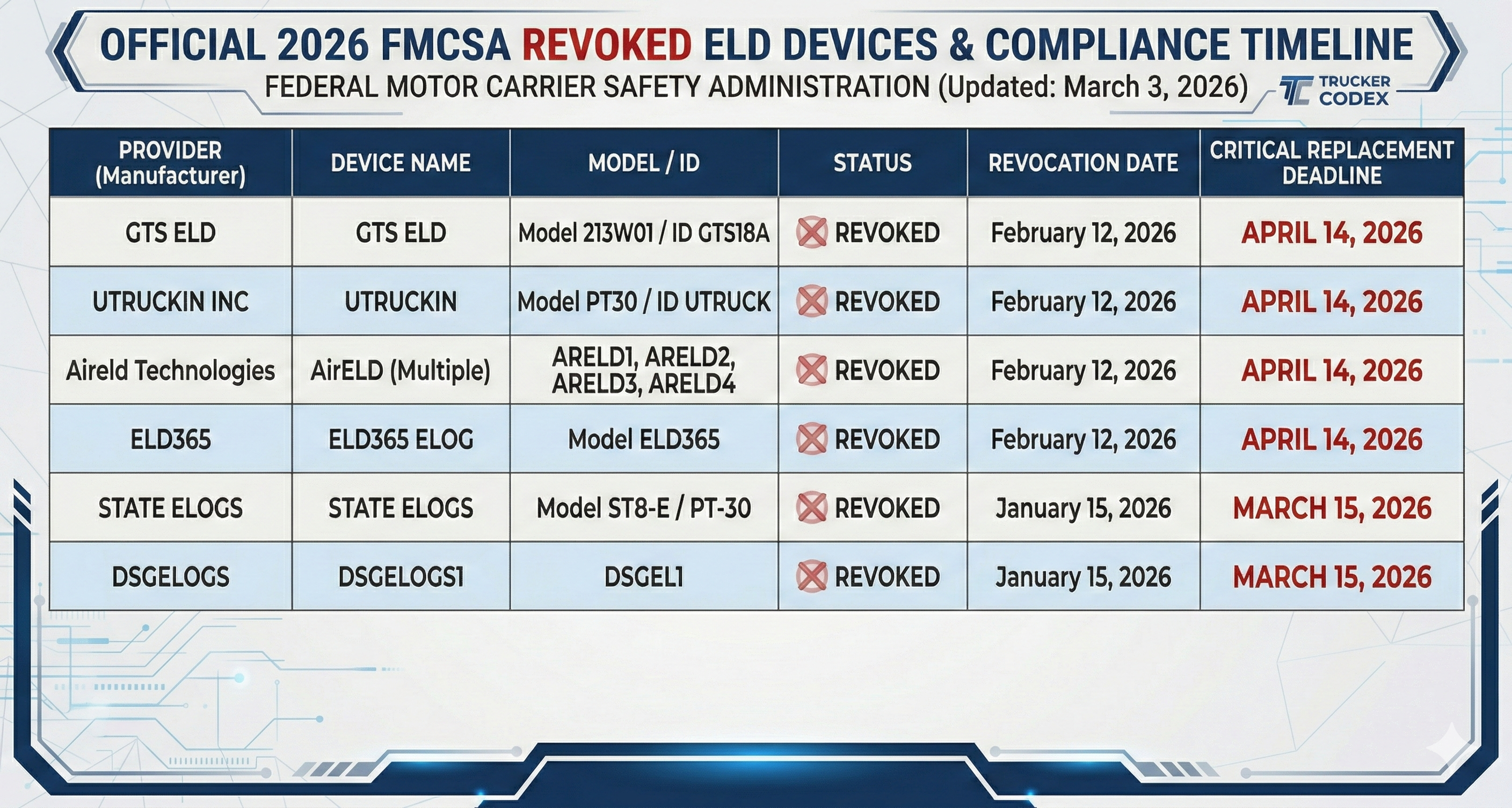
Official 2026 ELD Revocation Registry
The following table summarizes the federal enforcement actions taken in early 2026. If your provider is listed here, your countdown to potential OOS orders has already begun.
The 60-Day Compliance Window: A Mandatory Survival Strategy
When a device is revoked, carriers enter a mandatory 60-day transition period. This is not a “grace period” to continue business as usual; it is a critical window to replace non-compliant hardware. Failure to follow these steps precisely is a primary DOT compliance audit trigger that can lead to deeper investigations.
Phase 1: Immediate Reversion to Paper Logs
Under 49 CFR 395.34, if an ELD is revoked, drivers must immediately begin recording Hours of Service on manual paper logs. However, carriers must be aware that paper logs are only permitted for a maximum of 8 days unless a specific extension is granted by the FMCSA. This temporary measure is designed to allow the driver to complete their current trip without being placed Out-of-Service at the first scale house they encounter.
Phase 2: Hardware Sourcing and Installation
Carriers must select and install a new, registered device before the critical deadlines. This requires an immediate audit of your current inventory. If you are managing a large fleet, the logistical challenge of swapping hardware across multiple states within a 60-day window can be overwhelming. Waiting until the final week often leads to common DOT violations due to rushed installations or lack of driver training on the new system interface.
Phase 3: Data Migration and Audit Readiness
Compliance does not end with a new device. You must ensure that all historical data from the revoked device is archived to meet federal document retention standards. During a new entrant safety audit, an inspector will ask for logs from the period when the device was revoked. If you cannot produce the archived electronic records plus the 8 days of paper logs, you risk a failing audit grade and a “Conditional” safety rating.
🛠️ Professional Solution: ELD Revoked Emergency KitNavigating a revocation period without specific legal templates is a significant liability for owner-operators and fleets alike. Don’t risk an OOS order at the scale house. [**Purchase our ELD Revoked 2026 Emergency Kit FMCSA Paper Logbook & Malfunction Form**](https://www.etsy.com/listing/4458962278/eld-revoked-2026-emergency-kit-fmcsa) to secure the exact legal forms required to stay compliant while you transition your hardware.
Impact on Safety Ratings and Roadside Inspections
Using a revoked device after the federal deadline is a “critical” violation under 49 CFR 395.8(a)(1). This is one of the most heavily weighted violations in the CSA (Compliance, Safety, Accountability) system.
The Role of English Proficiency
In 2026, inspectors are increasingly scrutinizing English language proficiency during ELD-related stops. A driver must be able to explain why they are using paper logs and demonstrate how to transfer data from their new device. If a driver cannot communicate the technical status of their ELD, they may face additional roadside assessment violations that compound the initial ELD issue.
Out-of-Service (OOS) Consequences
If an inspector finds a driver operating with a revoked device past the 60-day window, the driver will be placed Out-of-Service. This results in towing fees, missed delivery windows, and a permanent red flag on the carrier’s profile. This is why maintaining a perfect Driver Qualification File and equipment log is non-negotiable for professional operations.
Strategies for Long-Term Compliance
To avoid the “revocation cycle,” carriers should prioritize providers with established technical stability rather than the lowest price point. The 2026 market has seen many “fly-by-night” ELD providers disappear after failing FMCSA audits.
- Monitor the Registry Weekly: Set a calendar alert to check the official FMCSA Revoked List.
- Review Reinstatements: While some providers have successfully navigated the reinstatement process, relying on a previously revoked provider carries inherent risks for future audits.
- Integrate Your Systems: Use a holistic approach to ELD compliance that connects logs to vehicle maintenance requirements and overall safety management.
Total Audit Protection: Trucker Codex Compliance SystemELD compliance is just one piece of the puzzle. A technical failure can lead to a comprehensive investigation into your drug testing, maintenance, and training records. Our Trucker Codex DOT Compliance Binder & FMCSA Audit-Ready System is a professional-grade solution that organizes your entire safety department into an audit-proof framework.
Conclusion
The 2026 ELD landscape is more rigorous than ever before. For professional carriers, the cost of a revoked ELD far exceeds the price of a new device—it includes lost time, legal fees, and potential loss of operating authority. Stay proactive by monitoring the latest FMCSA updates and ensuring your drivers are equipped with the tools to handle roadside inspections with confidence.