English Proficiency as an Out-of-Service Condition: 2026 Roadside Enforcement Breakdown
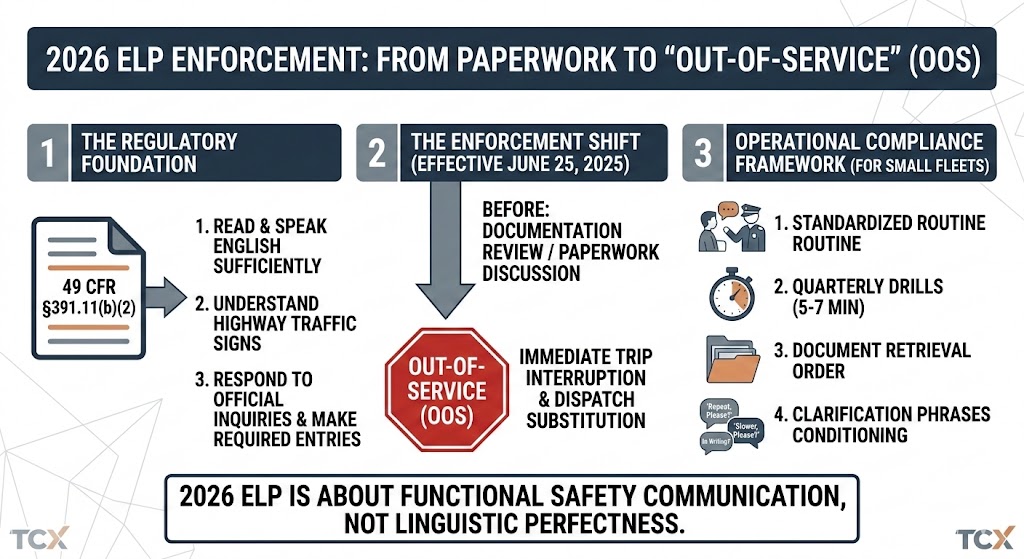
English language proficiency (ELP) is not a new regulatory concept. It has long been codified under 49 CFR §391.11(b)(2), which requires that a commercial motor vehicle driver be able to read and speak English sufficiently to converse with the general public, understand highway traffic signs and signals in English, respond to official inquiries, and make required entries on reports and records. The regulatory language is functional, not academic. It focuses on operational safety communication — not grammar perfection.
What changed in 2025–2026 was not the wording of the rule, but the enforcement consequence. Beginning June 25, 2025, FMCSA confirmed that English language proficiency violations would again be treated as an Out-of-Service (OOS) driver condition under roadside enforcement posture, aligning inspection outcomes with the existing regulatory requirement. This shift was addressed in official agency communications through the FMCSA newsroom announcement. The Commercial Vehicle Safety Alliance (CVSA), which maintains the North American Standard Out-of-Service Criteria used during inspections, likewise clarified enforcement alignment in its update regarding English language proficiency as an OOS condition, published at cvsa.org. FMCSA subsequently issued enforcement FAQs in early 2026 clarifying inspection posture and application, available via official guidance at fmcsa.dot.gov.
The practical consequence is operational. ELP non-compliance is no longer a paperwork discussion. It can result in immediate trip interruption during a roadside inspection.
How English Proficiency Is Evaluated at Roadside
ELP is assessed through the inspection interaction itself. Officers do not administer a classroom-style test. Instead, evaluation occurs through live communication consistent with §391.11(b)(2), typically across three contexts.
1. Sign and Signal Comprehension Drivers must be able to understand highway traffic signs in English. Inability to interpret regulatory or safety signage directly implicates the regulation.
2. Response to Official Inquiries During roadside inspections, drivers must answer routine safety questions regarding origin, destination, carrier identity, load type, and document location. A breakdown in comprehension or inability to respond sufficiently to maintain safety control may support an OOS determination under current enforcement posture. For inspection structure context, see DOT Roadside Inspection Levels and DOT Roadside Communication Structure.
3. Required Entries on Reports and Records The regulation explicitly requires drivers to make required entries in English. Inspection often transitions into documentation review, where language ability and record handling discipline intersect. Related frameworks are outlined in DOT Recordkeeping & Document Retention and Driver Qualification File Requirements.
It is important to distinguish between functional non-compliance and stylistic imperfection. Accent does not equal non-compliance. Minor grammar errors do not equal non-compliance. Nervousness under inspection does not equal non-compliance. The regulatory threshold is breakdown of comprehension and required communication — not linguistic polish.
Enforcement Risk Cascade
An ELP breakdown during roadside inspection can lead to immediate OOS declaration, interrupting the trip, forcing dispatch substitution, and potentially triggering broader compliance scrutiny. Enforcement events rarely exist in isolation. They interact with audit exposure and pattern analysis. See DOT Compliance Audit Triggers, Common DOT Violations and How to Avoid Them, and the broader enforcement shift overview in FMCSA & DOT Updates (2025–2026).
Operational Note: If your operation does not have a structured roadside communication protocol, a pre-built inspection framework can reduce enforcement friction. The TCX DOT Roadside Inspection Printable Kit is designed for small fleets and owner-operators seeking inspection readiness without administrative burden.
Minimal Control Framework for Small Fleets
Control does not require bureaucracy. It requires structured discipline.
A standardized roadside interaction routine should cover carrier identification, trip basics, documentation retrieval, clarification phrases, and instruction acknowledgment. A five-to-seven-minute quarterly drill is operational conditioning — not language certification. Drivers should also be verified for functional comprehension of core regulatory signage, directly aligning with §391.11(b)(2). Documentation retrieval order should remain fixed and inspection-ready to prevent communication breakdown during document requests.
Implementation Shortcut: Rather than drafting templates and drill structures from scratch, many carriers implement structured systems such as the TCX Roadside Inspection Kit to standardize document presentation and inspection interaction flow.
Clarification Phrase Conditioning
Inspection breakdowns often occur not because a driver lacks English ability, but because stress produces silence. Silence may be misinterpreted as non-comprehension.
Drivers should be conditioned to use professional clarification phrases such as:
“Could you please repeat that?” “Can you say that more slowly?” “May I see that in writing?” “I understand.”
These phrases demonstrate functional comprehension and prevent escalation caused by perceived non-responsiveness. Under 49 CFR §391.11(b)(2), sufficient ability to respond is the requirement. Controlled clarification is consistent with compliance.
Awareness of Standardized Inspection Question Domains (2026 Clarification)
FMCSA’s early-2026 FAQs clarified that English proficiency is evaluated through structured, consistent questioning rather than arbitrary exchanges. The agency emphasizes functional ability tied directly to regulatory requirements. Official clarification is available at fmcsa.dot.gov.
Drivers do not need advanced fluency. They need familiarity with predictable roadside question domains:
- Identity and carrier information
- Trip origin and destination
- Nature of cargo
- Compliance document location
- Instruction acknowledgment
Familiarity materially reduces inspection volatility.
Compliance Architecture Perspective
English proficiency enforcement in 2026 functions as an interactional control point within the broader roadside inspection system. It operates alongside mechanical OOS criteria, hours-of-service enforcement, and documentation review. Related structural analyses are available in DOT Roadside Inspection Levels, Common DOT Violations and How to Avoid Them, and DOT Compliance Audit Triggers.
Documentation of process should remain lightweight. There is no federal requirement for a language testing program. The requirement is functional ability. Maintaining a simple internal notation that roadside communication drills occur periodically supports defensibility without creating administrative drag.
Structured Compliance Approach: English proficiency enforcement becomes manageable when treated as a system control. For carriers seeking a ready-to-deploy inspection structure aligned with current enforcement posture, the TCX DOT Roadside Inspection Printable Kit provides a practical operational baseline.
English language proficiency enforcement in 2026 is not about linguistics. It is about functional safety communication under inspection conditions. Carriers that treat it as structured operational control — rather than abstraction — reduce the probability of immediate OOS disruption and downstream enforcement escalation.