DOT Compliance Documents: The Complete List Truck Drivers Must Maintain
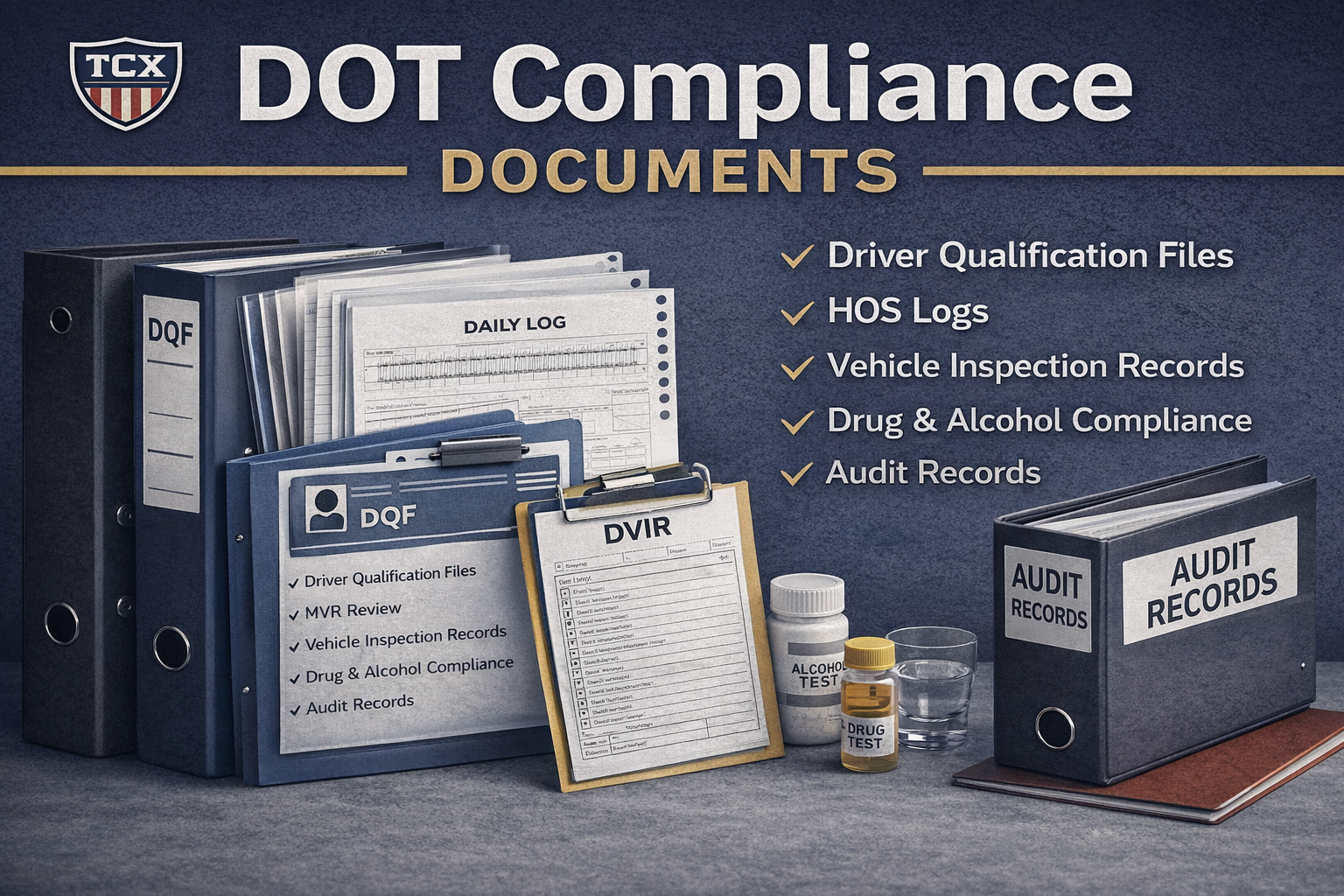
DOT compliance in trucking is fundamentally a documentation system. While safe driving practices and proper vehicle maintenance are essential, federal enforcement agencies primarily verify compliance through records.
During roadside inspections, safety audits, and compliance reviews, regulators rarely ask what a driver “knows.” Instead, they examine what documentation exists and whether those records demonstrate an active compliance system.
For a full explanation of the regulatory framework behind these requirements, start with the foundational guide: What Is DOT Compliance.
This article focuses specifically on the documents truck drivers and motor carriers must maintain to demonstrate operational compliance with federal safety regulations.
Core DOT Compliance Document Categories
Most DOT compliance documentation falls into four operational groups:
- Driver qualification documentation
- Hours-of-Service and log records
- Vehicle inspection and maintenance documentation
- Drug and alcohol testing program records
Each category corresponds to a major area of federal motor carrier regulation and is routinely examined during roadside inspections and safety audits.
Driver Qualification Documents
The Driver Qualification File (DQF) is the central documentation system proving that a driver is legally qualified to operate a commercial motor vehicle.
Federal regulations require carriers to maintain a qualification file for each driver operating under their authority. These files demonstrate that the carrier actively verifies driver eligibility and monitors qualification status.
A detailed breakdown of required DQF components is explained in Driver Qualification File Requirements.
Typical Driver Qualification File records include:
- CDL verification
- Medical examiner certificate status
- Motor Vehicle Record reviews
- Safety performance history inquiries
- Driver certification statements
Incomplete or outdated DQF documentation is one of the most common causes of audit failure during compliance reviews.
Hiring procedures also play a role in qualification compliance. These procedures are explained in DOT Pre-Employment Requirements.
Drug and alcohol compliance verification is connected to driver qualification through the federal Clearinghouse system. The structure of this system is explained in FMCSA Clearinghouse Guide.
Hours-of-Service Documentation
Hours-of-Service regulations limit driving time in order to reduce fatigue-related crash risk.
The regulatory framework behind these rules is explained in Hours of Service Rules.
To demonstrate compliance with HOS regulations, drivers must maintain accurate duty status records. These records may include:
- Electronic Logging Device (ELD) data
- Records of duty status (RODS)
- Supporting operational documents
- Log annotations and edits
Modern compliance systems rely heavily on electronic logging devices. The technical framework behind these devices is explained in Electronic Logging Device Compliance.
Incorrect log records or inconsistent supporting documentation can result in enforcement violations. A detailed explanation of enforcement outcomes is available in Hours-of-Service Violations (Out-of-Service).
Vehicle Inspection and Maintenance Records
Federal regulations require commercial vehicles to be inspected regularly, mechanical defects to be corrected, and maintenance activity to be documented.
The regulatory expectations for vehicle maintenance systems are explained in DOT Vehicle Inspection and Maintenance Requirements.
Typical maintenance documentation includes:
- Driver vehicle inspection reports
- Mechanical defect documentation
- Repair records
- Annual inspection reports
- Maintenance history logs
These records demonstrate that a carrier operates a structured mechanical safety program rather than reacting only when failures occur.
Certain mechanical failures can trigger immediate enforcement action. Two common Out-of-Service categories involve brake system failures and tire defects.
The enforcement criteria for these violations are explained in:
Drug and Alcohol Compliance Records
Drivers operating regulated commercial vehicles must participate in a federally mandated drug and alcohol testing program.
Compliance documentation for this program typically includes:
- Pre-employment testing verification
- Random testing program participation records
- Post-accident testing documentation
- Return-to-duty documentation when applicable
Drug and alcohol program participation is monitored through the FMCSA Clearinghouse system.
A full explanation of Clearinghouse procedures and documentation requirements is available in FMCSA Clearinghouse Guide.
Failure to maintain documentation in this area can lead to severe regulatory consequences.
Recordkeeping and Document Retention
Compliance documentation must not only exist but also be stored correctly and retained for the required regulatory period.
A detailed explanation of DOT record retention systems is provided in DOT Recordkeeping and Document Retention Requirements.
A structured recordkeeping system ensures that:
- compliance records are properly organized
- required retention periods are respected
- documents can be produced quickly during inspections or audits
Many enforcement actions occur not because safety controls were absent but because documentation could not be produced when regulators requested it.
Roadside Inspections and Documentation
During roadside inspections, enforcement officers evaluate documentation together with vehicle condition.
An overview of inspection types is available in DOT Roadside Inspection Levels.
Drivers must also communicate clearly and provide requested documentation efficiently during inspections. Communication discipline during enforcement encounters is explained in DOT Roadside Communication Structure.
A practical procedural survival framework can be found in the Roadside Inspection Survival Guide.
Compliance Audits and Document Requests
During compliance reviews or safety audits, regulators typically request documentation across several operational areas.
Common audit documentation requests include:
- Driver Qualification Files
- Hours-of-Service records
- vehicle maintenance documentation
- drug and alcohol testing program records
- accident registers and safety management documentation
Carriers that understand enforcement triggers can prepare documentation systems proactively. The selection process is explained in DOT Compliance Audit Triggers.
New motor carriers should also understand the federal audit framework described in New Entrant Safety Audit: FMCSA Methodology.
Why Documentation Determines Compliance
DOT compliance is not judged by intention. It is judged by evidence.
Drivers and carriers who maintain structured documentation systems can demonstrate regulatory control during inspections and audits. Those who cannot produce records are often treated as if the compliance system never existed.
For a broader explanation of how these documentation systems fit into the overall regulatory structure, return to the foundational guide: What Is DOT Compliance.