DOT Compliance Checklist (2026)
DOT compliance is not “a few forms.” It is an operating system: a set of federal safety requirements that commercial drivers and motor carriers must follow, then prove through documentation and enforcement-facing readiness.
If you want the full concept first, read What Is DOT Compliance?. This page is the tactical layer: a working checklist you can run weekly and monthly.
The 5 Core DOT Compliance Domains
A practical DOT compliance program usually breaks into five domains:
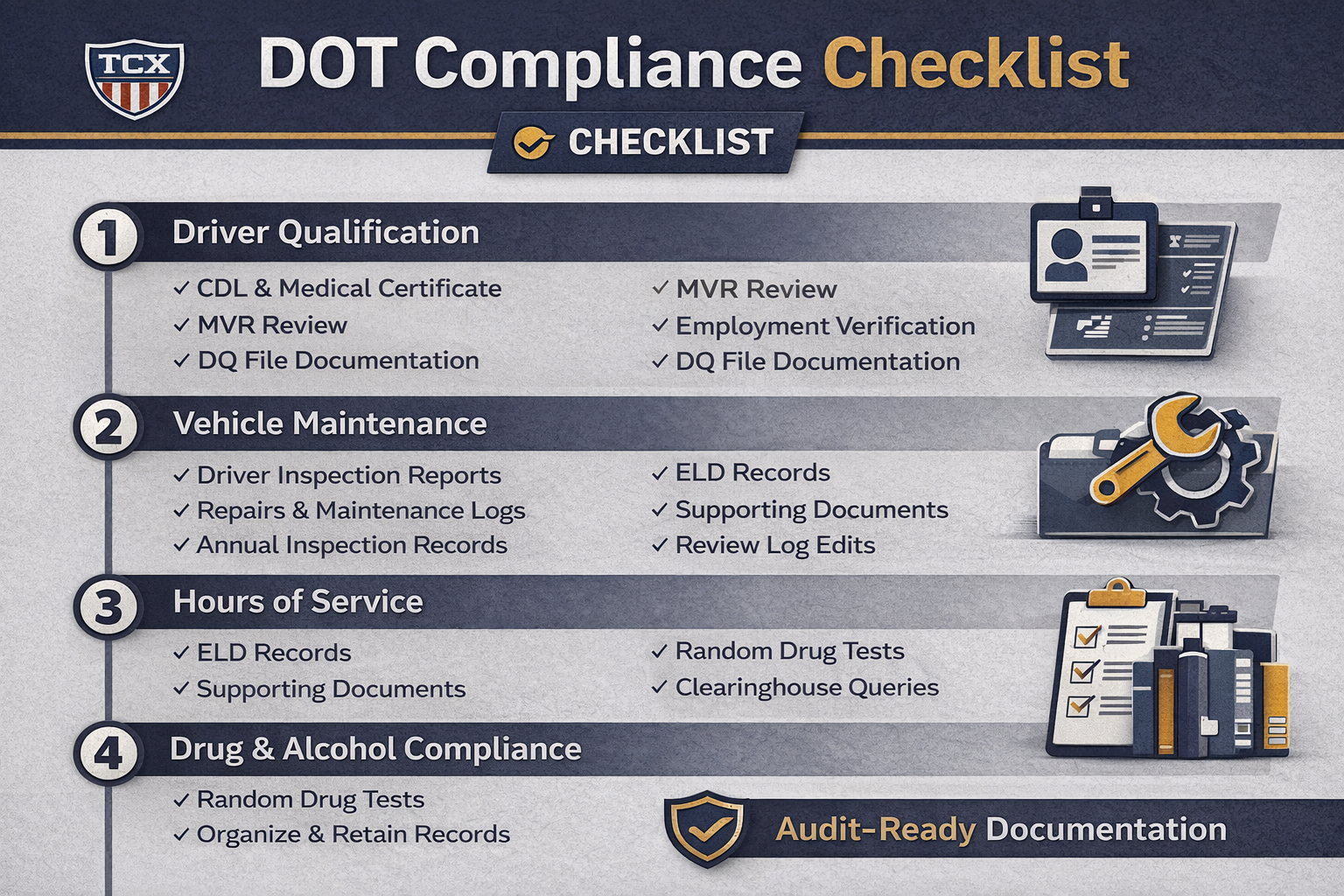
1) Driver Qualification Files (DQF) 2) Hours-of-Service (HOS) + ELD/RODS accuracy 3) Vehicle inspection, repair, and maintenance 4) Drug & alcohol compliance (Clearinghouse controls included) 5) Recordkeeping + retention discipline
Each domain below includes: what to maintain, what gets checked, and where violations typically happen.
1) Driver Qualification File (DQF)
The Driver Qualification File is your proof file. It demonstrates the driver is legally qualified and the carrier maintains qualification controls.
Use the full TCX guide for structure and required elements: Driver Qualification File (DQF) Requirements.
DQF checklist (operational)
- Driver identity and CDL verification (current and legible)
- Medical certification status tracked and current
- Annual MVR review system (not ad-hoc)
- Prior employer / safety performance verification process
- Violation and certification documents updated on schedule
Pre-employment gaps are a frequent audit failure point. Keep your hiring controls clean using DOT Pre-Employment Requirements.
Drug/alcohol compliance connects to qualification through Clearinghouse controls. The practical framework is here: FMCSA Clearinghouse Guide.
2) Hours-of-Service (HOS) and Log Accuracy
HOS compliance is enforced through duty status records and supporting documentation. Even a safe driver can be cited for log integrity failures.
Start with the baseline rules: Hours of Service Rules.
HOS/RODS checklist
- Duty status records current, consistent, and reviewable
- Supporting documents match the log narrative (fuel, bills, etc.)
- Edits and annotations are controlled and defensible
- Log review cadence exists (weekly review is a common minimum)
Most modern enforcement assumes ELD controls. The ELD framework is here: Electronic Logging Device (ELD) Compliance.
Certain patterns can become Out-of-Service exposure. Use Hours-of-Service Violations (Out-of-Service) as the enforcement lens.
2026 device-level risk (ELD revocations)
ELD compliance includes device status. Revocations change your risk profile fast. Track 2026 posture here:
- 2026 ELD Compliance Standards & Revocation Updates
- FMCSA 2026 ELD Revocations Analysis
- FMCSA 2026 Update: Revoked ELD Devices + Compliance Strategies
3) Vehicle Inspection, Repair, and Maintenance
Vehicle compliance is not only mechanical condition. Documentation proves an inspection/repair system exists and defects are corrected.
Use the full guide: DOT Vehicle Inspection & Maintenance Requirements.
Maintenance checklist (audit-grade)
- Driver inspection routine exists (pre/post) and is documented
- Defect reporting is captured, not verbal-only
- Repairs are documented with dates and identifiers
- Periodic/annual inspections are documented and retrievable
- Repeat defects are tracked to root cause (pattern control)
Two common Out-of-Service categories worth treating as “high-risk controls”:
4) Drug & Alcohol Compliance (Clearinghouse)
Drug and alcohol compliance is not optional for regulated operations. Enforcement checks program participation, random testing administration, and violation handling.
Use the system guide: FMCSA Clearinghouse Guide.
Program checklist
- Pre-employment testing and documentation workflow exists
- Random testing process exists (and records are retained)
- Post-accident procedures are defined and executed consistently
- Return-to-duty process is documented when applicable
- Clearinghouse queries are performed as required and logged
5) Recordkeeping and Retention Discipline
Most compliance failures are “paper failures.” Operations can be safe while records are incomplete, missing, or not retrievable on demand.
Use the full retention and system guide: DOT Recordkeeping & Document Retention Requirements.
Recordkeeping checklist
- Records are organized in one consistent system (not scattered)
- Retention windows are respected (nothing deleted early)
- Retrieval is fast (you can produce in minutes, not hours)
- Periodic review is scheduled (monthly minimum is common)
- Expiration-driven items have alerts (medical cards, etc.)
Roadside Inspection Readiness
Roadside enforcement is where compliance becomes real. You are evaluated under time pressure, with limited tolerance for confusion.
Understand inspection types and what is checked: DOT Roadside Inspections (Levels).
Communication posture matters. Use: DOT Roadside Communication Structure.
For a full procedural protocol, read: Roadside Inspection Survival Guide.
Audit Preparation Checklist (What Auditors Actually Pull)
Audits and compliance reviews typically request evidence across the same five domains:
- DQF completeness and currency
- HOS/ELD integrity
- Maintenance system + repair documentation
- Drug/alcohol program evidence
- Recordkeeping and retention controls
If you want the “why did they select this carrier?” angle, use: DOT Compliance Audit Triggers.
New authorities should study the audit structure early:
Common DOT Compliance Mistakes
Most violations are avoidable. The pattern is predictable: missing documents, weak systems, and inconsistent logs.
Start with this enforcement-focused breakdown: Common DOT Violations and How to Avoid Them.
Quick Reference: Run This Weekly
- Check upcoming expirations (medical, required docs)
- Review HOS/ELD exceptions and edits
- Confirm DVIR/defect workflow is captured and repairs documented
- Confirm record storage is complete and retrievable
This checklist is designed to feed your pillar system and strengthen your compliance architecture over time.
For the full DOT compliance framework page, return to: What Is DOT Compliance?.