Clearinghouse Phase II: CDL Downgrade Enforcement — What Carriers and Drivers Must Do Right Now
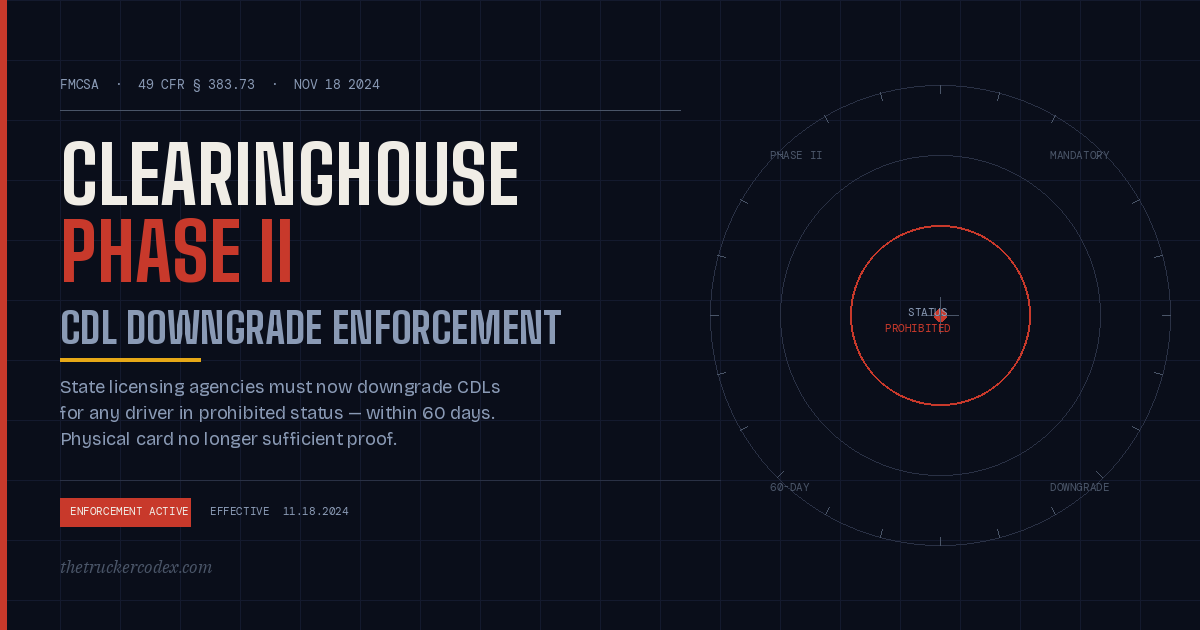
The FMCSA Drug and Alcohol Clearinghouse has had two distinct phases. Phase I closed the loophole that let prohibited drivers move between carriers undetected. Phase II closes the second loophole: drivers in “prohibited” status who were still holding valid CDLs because their state licensing agency had no obligation to act.
That obligation is now mandatory. As of November 18, 2024, State Driver Licensing Agencies (SDLAs) are required to remove commercial driving privileges from any driver with a “prohibited” Clearinghouse status. The credential itself — not just the driving authorization — is now at stake.
If you operate a small fleet or run as an owner-operator, this is not a background-level compliance topic. It is an operational risk that sits inside your Driver Qualification File, your pre-employment process, and your annual query obligations.
What Phase I Did — and What It Left Open
Phase I, effective January 6, 2020, required employers to query the Clearinghouse before hiring CDL drivers and annually for all current drivers. It created a central record of drug and alcohol violations and prohibited drivers from operating CMVs.
What it did not do: force states to downgrade the actual CDL. A driver could be “prohibited” in the federal system and still hold a physically valid state-issued CDL. Some states were querying voluntarily. Most were not. The result was a predictable enforcement gap.
Phase II — the second Clearinghouse final rule (86 FR 55718) — eliminates that gap by making SDLA participation mandatory.
What Changed on November 18, 2024
Under 49 CFR § 383.73, SDLAs are now required to:
- Query the FMCSA Clearinghouse before issuing, renewing, upgrading, or transferring any CDL or CLP
- Initiate a CDL downgrade within 60 days of receiving notification that a driver holds “prohibited” status
- Decline to issue duplicate credentials to prohibited drivers
- Reinstate commercial driving privileges only after FMCSA notifies them that a driver’s status has changed to “not prohibited”
The physical CDL card in a driver’s wallet is no longer sufficient evidence of valid commercial driving authority. What matters is the system-of-record status in CDLIS — and that status now flows directly from the Clearinghouse.
A law enforcement officer can cite a driver for operating a CMV without a valid CDL even if the driver presents a physical card that hasn’t yet been physically recalled. The downgrade is effective in the system before the card is surrendered.
The Carrier’s Exposure
This is where many small carriers and owner-operators are underestimating the risk.
Pre-employment queries are now doubly important. If you hire a driver without running a full Clearinghouse query and that driver is in “prohibited” status, you have placed a disqualified driver in a safety-sensitive function. Under FMCSA enforcement, this is not a paperwork deficiency — it is a knowing violation with civil penalty exposure.
Annual limited queries are not sufficient for new hires. A limited query tells you whether a record exists; it does not give you the content. For any new hire, a full query with the driver’s electronic consent is required before the driver operates a CMV. Refusing to provide consent is itself treated as a violation under 49 CFR Part 382.
Your DQF is the audit trail. If a Clearinghouse violation surfaces during a compliance review and you cannot demonstrate that you ran the required queries, the documentation gap compounds the underlying problem. Auditors examine pre-employment query records as a standard component of Driver Qualification File reviews.
For an overview of what belongs in that file, see Driver Qualification File Requirements.
DQF Tab — The Trucker Codex binder system includes a dedicated Driver Qualification File section with the filing structure, checklists, and retention schedule auditors expect. See what’s included →
The 60-Day Window and What It Means Operationally
Once an SDLA receives notification of a driver’s “prohibited” status, they have 60 days to complete the downgrade in the CDLIS record. Some states, including Texas, have been acting significantly faster than the 60-day ceiling.
For carriers, this creates a practical planning problem. A driver’s CDL status can change mid-employment, between your annual query cycle and the next check. You will not receive automatic notification unless you are running queries. The annual limited query cycle — designed as a minimum floor, not a complete program — was never intended to catch mid-year status changes. Under Phase II, those mid-year changes now have credential consequences that compound quickly.
A driver whose CDL is downgraded mid-route is not just a compliance problem; it is an operational disruption. The load doesn’t move, the customer doesn’t care about the regulatory timeline, and the carrier absorbs the fallout. Prevention is substantially cheaper than the alternative.
Control: Run a full Clearinghouse query immediately upon any drug or alcohol program event — do not wait for the annual cycle. Treat a positive test or refusal as a trigger event, not just a documentation item.
The standard query obligations are covered in our FMCSA Clearinghouse Guide.
The Return-to-Duty (RTD) Path
A CDL downgrade is not permanent. The path back is structured under 49 CFR Part 40, Subpart O, and involves:
- SAP Evaluation — A qualified Substance Abuse Professional assesses the driver and recommends treatment or education
- Program Compliance — The driver completes the prescribed treatment or education program
- RTD Drug/Alcohol Test — A supervised, negative test result is required before return
- Follow-Up Testing — Unannounced tests over a minimum of 12 months, up to 60 months
Once the RTD process is complete and the Clearinghouse status updates to “not prohibited,” FMCSA notifies the SDLA, which then reinstates commercial driving privileges. The driver can then apply for CDL reinstatement.
FMCSA’s Return-to-Duty resources include a Quick Reference Guide and step-by-step video.
Drug & Alcohol Tab — TCX Vol.1 includes a Drug & Alcohol Program section with SAP referral tracking, RTD documentation, and follow-up testing logs — organized the same way your binder’s other five sections are. View the system →
What a Clearinghouse Violation Looks Like at Audit
A compliance review that surfaces a Clearinghouse gap will typically examine:
- Pre-employment query records for each CDL driver
- Annual limited query logs (required for every currently employed driver, every 12 months)
- Evidence that drivers with violations were removed from safety-sensitive functions immediately
- Documentation that full queries were completed when a limited query returned a “record exists” result
The sequence matters. An auditor will not just ask whether you ran queries — they will ask whether you ran them at the right time and acted on the results correctly. A pre-employment query run after the driver’s first dispatch is not compliant. An annual limited query that returned a “record exists” result, followed by no full query, is not compliant. The documentation must show both the query and the response to it.
This is a failure pattern FMCSA sees consistently in small operations: queries are run but not logged, logged but not stored in the DQF, stored in the DQF but in the wrong section. Each gap is its own finding. In a compliance review, three paperwork findings in the same regulatory area can move a carrier’s safety rating — a consequence that vastly outweighs the cost of maintaining a clean system from the start.
Failure to maintain these records is a direct DOT compliance audit trigger — and the audit exposure compounds if a violation is discovered that the carrier could have detected through required queries.
For a complete record retention framework, see DOT Recordkeeping and Document Retention.
Compliance Controls — What to Do Now
For carriers and owner-operators:
- Run a full Clearinghouse query on every currently employed CDL driver if you have not done so in the past 12 months
- Verify that your annual limited query calendar is current for all drivers
- Confirm that your pre-employment process requires a full query before any new CDL driver operates a CMV
- Document all query results and store them in the Driver Qualification File
- If a driver returns a “prohibited” status, remove them from safety-sensitive functions immediately — same day, not within the grace period
- Do not rely on the physical CDL card as proof of valid commercial driving authority — verify CDLIS status
For a consolidated 2026 compliance checklist, see DOT Compliance Checklist 2026.
If you want all six compliance areas — DQF, Drug & Alcohol, HOS, Vehicle Maintenance, Insurance, and Company Files — organized into one indexed binder that’s built for owner-operators and small fleets, TCX Vol.1 is on Etsy. Set it up once, maintain it weekly.
Related Compliance Topics
- FMCSA Clearinghouse Guide
- Driver Qualification File Requirements
- DOT Pre-Employment Requirements
- DOT Compliance Audit Triggers
- DOT Recordkeeping and Document Retention
Regulatory references verified against FMCSA official sources. This post is for informational purposes only and does not constitute legal advice.